Workout done. You look at your wrist. 900 kcal.
Great. Now you can eat based on that number. Right?
Wrong. In fact, that number could throw off everything else: your meal plan, your energy availability, even the conclusion “I’m eating too much” or “I’m eating too little.”
Today we find out how far you can trust that number.
Spoiler: less than you think.
How do you measure metabolism "for real"?
The reference method is called indirect calorimetry.
Keeping it very, very simple: to produce energy, your body uses oxygen and produces carbon dioxide. Measure both gases precisely and you can work out the energy.
You don’t measure heat. You measure breath.
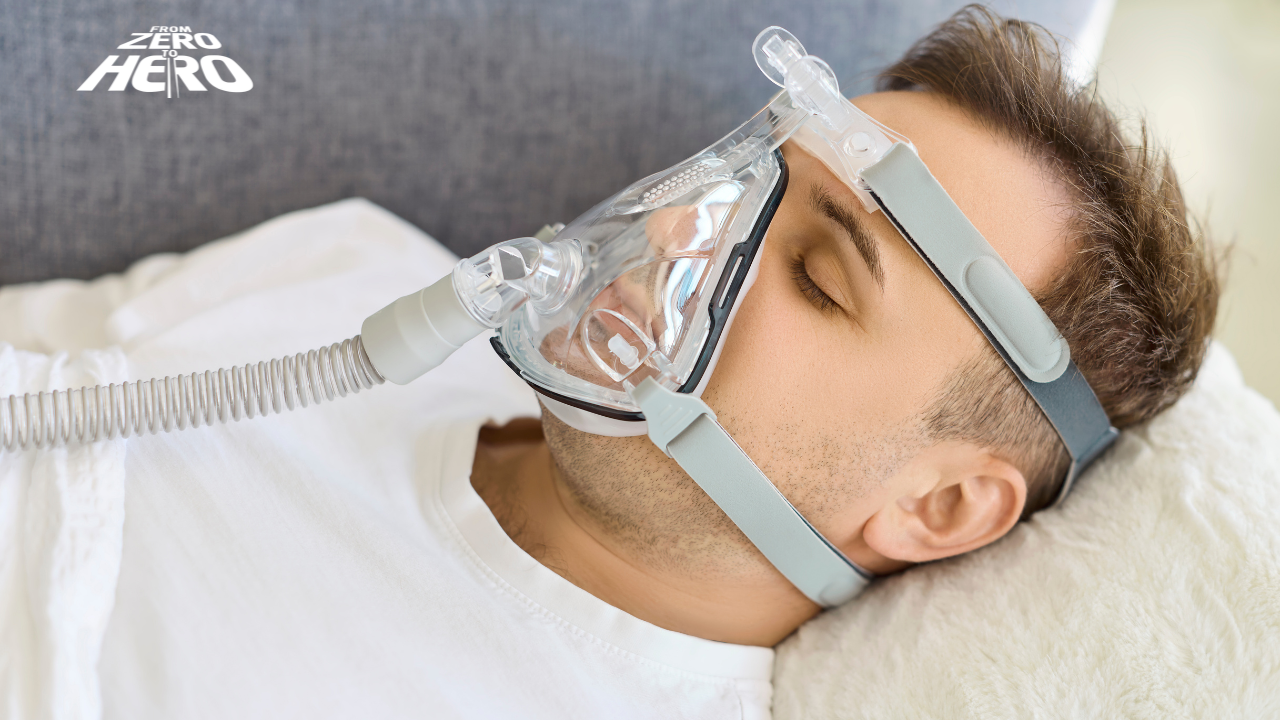
In practice you lie down, awake, with a mask, for about half an hour.
Careful! It only works if it’s done properly. You need:
◦ fasting (the meta-analysis we’re discussing mentions at least 7 hours)
◦ no caffeine for at least 4 hours
◦ no nicotine for at least 2.5 hours
◦ no hard exercise the day before
How many of these rules did the analysed studies follow, on average?
Out of 10 good-practice criteria: 5.
Even the “gold standard” needs a critical eye.
How many formulas exist for resting metabolism?
Not everyone has a metabolic cart. So we use formulas: weight, height, age, sex, sometimes lean mass.
A 2023 meta-analysis (Sports Medicine) put together 29 studies and 1,430 athletes.
Guess how many different formulas it found? One hundred.
That alone tells you the perfect formula doesn’t exist.
And there’s more: Harris-Benedict is over a hundred years old and was built on non-athletes. 16 men were removed from the original data precisely because they were trained.
We’re using tools born without athletes to measure athletes. Does that add up?
How much does the result change for the same athlete?
Let’s pretend. A rower: 70 kg, 15% body fat (59.5 kg of lean mass), 1.85 m, 25 years old. Four formulas, same morning:
◦ Mifflin-St Jeor: about 1,740 kcal
◦ Harris-Benedict: about 1,785 kcal
◦ Cunningham: about 1,810 kcal
◦ De Lorenzo: about 1,940 kcal
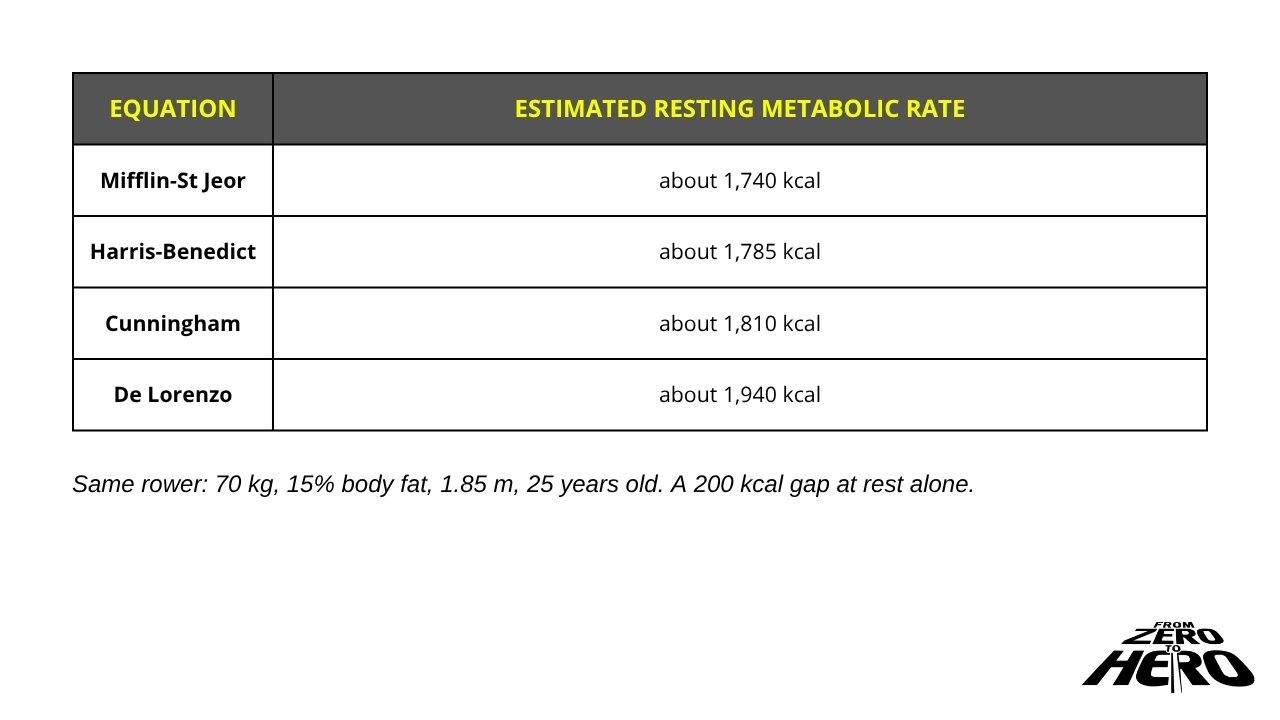
That’s a 200 kcal gap at rest alone.
Multiply by the activity factor (a PAL of 2 is not exaggerated for a rower in a heavy training block) and you get 400 kcal per day of difference, depending on which formula you picked.
And without measuring him, nobody knows which one is right for him.
Why are athletes the most at risk?
Here the number is genuinely scary, especially if you come from the rowing world.
The meta-analysis cites a study on elite male rowers and canoeists: Harris-Benedict underestimated resting metabolism by about 500 kcal. With a PAL of 2 or more, the error on daily needs could exceed 1,000 kcal.
A thousand calories is a meal and a half. It’s the difference between an athlete who recovers and one who drags himself through the session.
Scientific honesty: the authors themselves admit part of the gap could come from athletes already in low energy availability, with a lowered metabolism.
The message still stands: in big, muscular athletes, general-population formulas can be way off.
Which formula works best in athletes?
Two words to keep apart: accuracy (on average, are the arrows close to the bullseye?) and precision (how many arrows, one by one, land close to it?).
A formula can be right on average and badly wrong for the single athlete. Results of the meta-analysis:
◦ The only formula that was accurate and consistent across studies is ten Haaf (age, weight, height): it gets 80.2% of athletes within 10%
◦ The others range from 40.7% to 63.7%
◦ Even with the best one, one athlete in five is off by more than 10%
◦ Not recommended in athletes: Mifflin-St Jeor, Owen, FAO/WHO and Nelson
Important limit: the studies cover adults aged 18 to 35. For masters and teenagers this meta-analysis has no answers.
And watches? Only 11% have been validated
A 2024 umbrella review (Sports Medicine) pulled together 24 systematic reviews and 249 validation studies.
Since 2003, 310 devices from 20 brands have come out. How many have been validated for at least one measure?
34. That’s 11%.
If each device measures at least five things (steps, heart rate, sleep, activity, calories), you’d need 1,550 validations. Only 54 have been done. That’s 3.5%.
What do they measure well? Heart rate, with errors around 3%.
Calories, on the other hand, your watch doesn’t measure: it estimates. It takes heartbeat, wrist movement, weight and age and feeds them to an algorithm.
It’s like estimating a car’s fuel consumption by looking at the rev counter and how much the dashboard shakes. It tells you something. But it’s not the fuel tank.
How wrong are the calories?
A meta-analysis on Fitbit (Chevance, 2022) says: on average they underestimate by 2.77 kcal per minute. Sounds small.
But for the individual athlete the range goes from about −12.75 to +7.41 kcal per minute.
Do the maths for one hour of training:
◦ on average: about 166 kcal too low
◦ for the individual: from about 765 kcal too low to about 445 kcal too high
That “900” could be 1,300 or 500.
What about run and boats?
Almost all studies are done on treadmills. But in intermittent sports, with accelerations and changes of direction, things get worse.
A 2026 review (11 studies, 188 athletes) found that energy expenditure is the least accurate parameter, with systematic underestimation. In running with changes of direction the estimate was 52% too low, versus 34% in straight-line running.
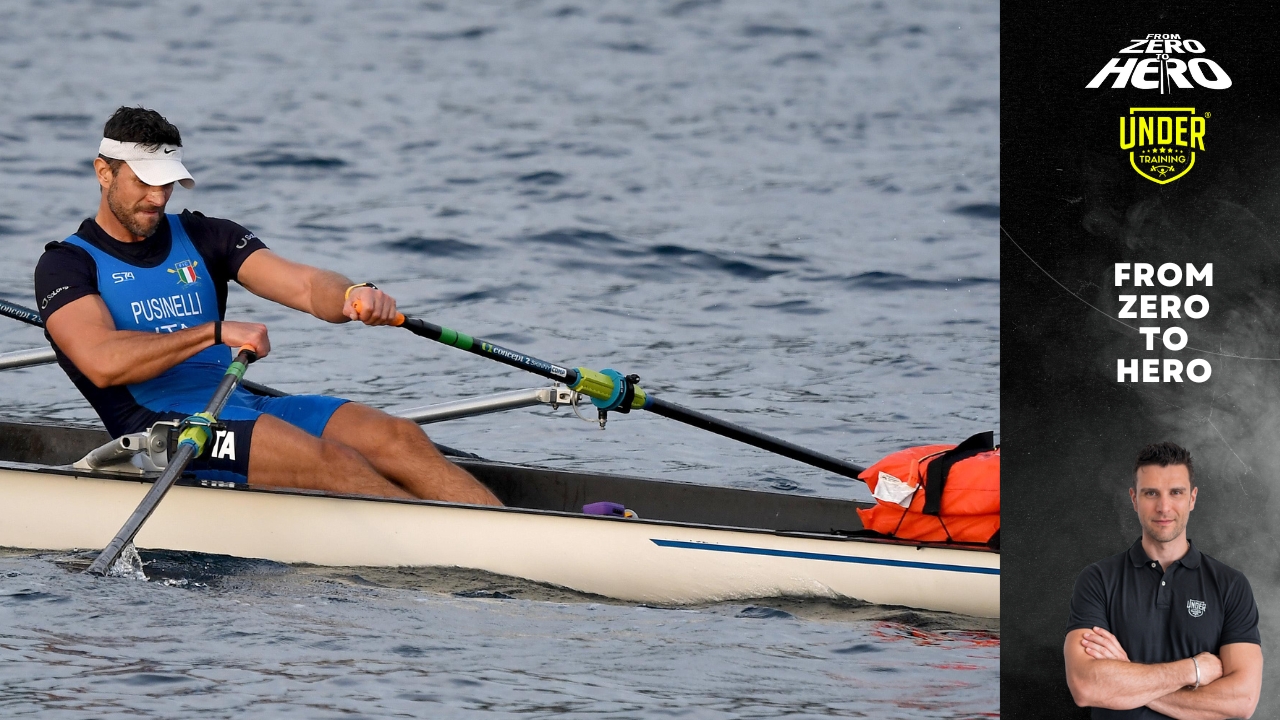
Now a hunch of mine, not written in the reviews: beach sprint is exactly that kind of sport. Running on sand, entering the boat, sprinting.
On a watch’s calories, there, I wouldn’t trust it.
For long-boat rowing I found no validation studies: so no numbers, just caution.
Watch or no watch? Pros and cons
✅ Pros
◦ Handy, always on your wrist, cheap compared to a lab
◦ Great for heart rate
◦ Useful to see trends over time, with the same athlete and the same device
❌ Cons
◦ Calories are an estimate, not a measurement
◦ Almost no model has been validated
◦ A software update can change the algorithm
◦ In power and intermittent sports the error is bigger
Today’s myth? “I eat the calories my watch tells me.”
No. If it tends to underestimate, you risk eating less than you need.
And low energy availability is exactly the problem we started from.
So remember to:
1. Treat expenditure as an estimate, not a reading.
2. Use indirect calorimetry if you can, but only with rigorous preparation.
3. Pick a formula built on athletes like you (and leave Mifflin, Owen, FAO/WHO and Nelson in the drawer).
4. Use your watch for heart rate and trends, not as a counter of calories to eat.
5. Always check the number against the athlete: weight over time, body composition, performance, recovery. The body isn’t stupid: in the end it gives you the balance sheet.
And if something doesn’t add up, the reference is a professional, not the app. 💡
In the next episode we stay on energy and talk about weight-category sports: where strategy ends and risk begins.
What are you waiting for?
Want help working out what you really need? Request your FREE CONSULTATION from the Contact page and join the FromZeroToHero program: become a SUPER ATHLETE yourself! 🚀
Always in shape!
SOURCES
Doherty C, Baldwin M, Keogh A, Caulfield B, Argent R. Keeping Pace with Wearables: A Living Umbrella Review of Systematic Reviews Evaluating the Accuracy of Consumer Wearable Technologies in Health Measurement. Sports Medicine. 2024. PMID 39080098. DOI 10.1007/s40279-024-02077-2
O’Neill JER, Corish CA, Horner K. Accuracy of Resting Metabolic Rate Prediction Equations in Athletes: A Systematic Review with Meta-analysis. Sports Medicine. 2023. PMID 37632665. DOI 10.1007/s40279-023-01896-z
ten Haaf T, Weijs PJM. Resting Energy Expenditure Prediction in Recreational Athletes of 18–35 Years: Confirmation of Cunningham Equation and an Improved Weight-Based Alternative. PLoS One. 2014. PMID 25275434. DOI 10.1371/journal.pone.0108460
Čokorilo N, Manolopoulos N, Matijević T, Rajović R. How Valid Are Wearable Devices in Team Sports? A Systematic Review. Sports (Basel). 2026. PMID 42506806. DOI 10.3390/sports14070264
Chevance G, et al. Accuracy and Precision of Energy Expenditure, Heart Rate, and Steps Measured by Combined-Sensing Fitbits Against Reference Measures: Systematic Review and Meta-analysis. JMIR mHealth and uHealth. 2022. PMID 35416777. DOI 10.2196/35626
Choe JP, Kang M. Apple Watch accuracy in monitoring health metrics: a systematic review and meta-analysis. Physiological Measurement. 2025. PMID 40199339. DOI 10.1088/1361-6579/adca82 (abstract only)